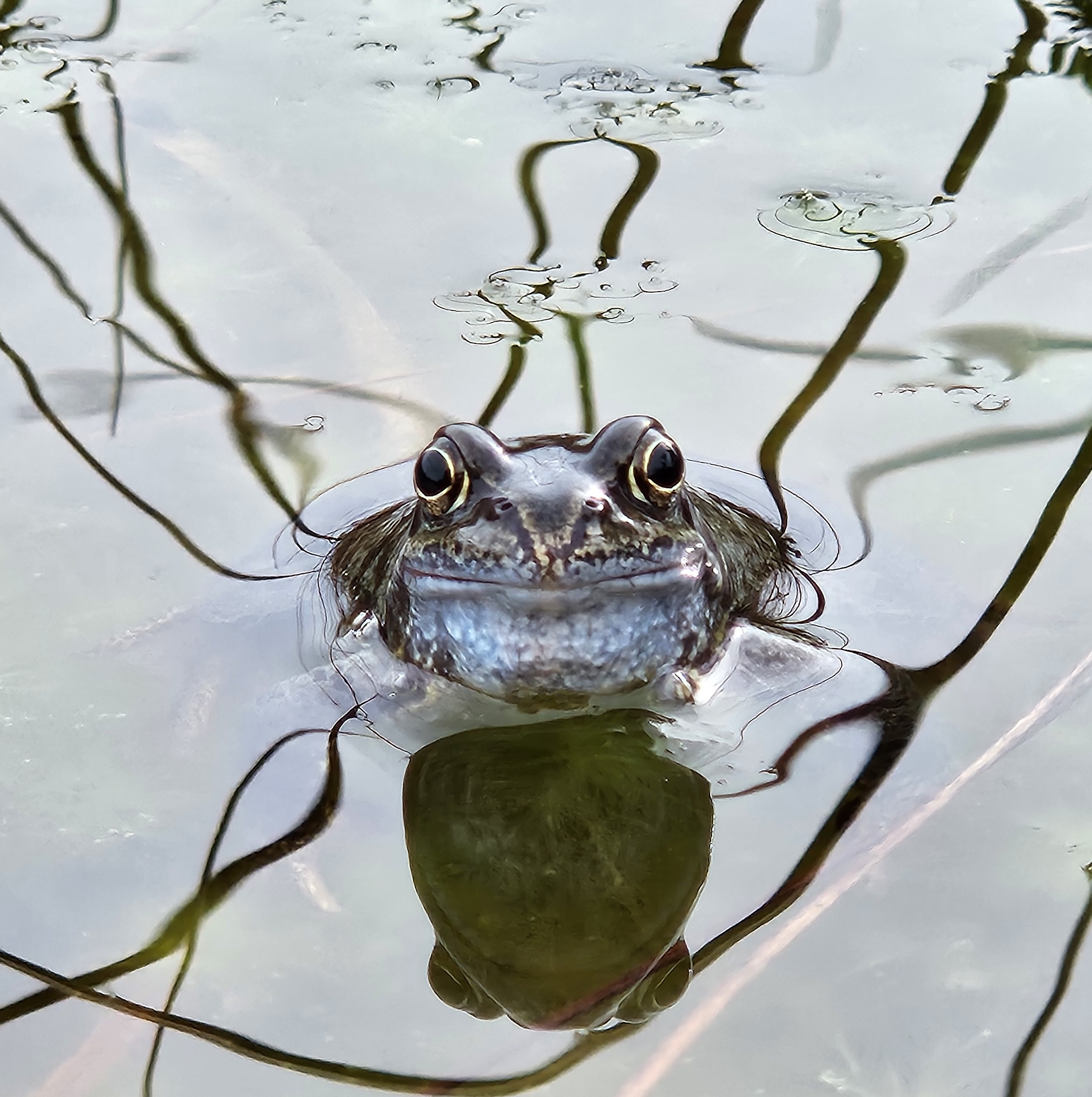
Louth County Council’s Biodiversity Office is seeking support from members of the public to record sightings of the Common Frog across County Louth.
By capturing small pieces of information, many people together can create powerful datasets that help scientists understand the environment, track changes over time, and support better decision‑making for nature and biodiversity.
This is why Louth County Council, in partnership with the Irish Peatlands Conservation Council, is seeking the public’s help to paint a clearer picture of how frogs are faring across the county. Since 1997 the Irish Peatland Conservation Council has coordinated Ireland’s longest running frog survey, the “Hop To It” frog survey. This citizen science initiative asks members of the public to record and submit their observations of the various stages of the Common Frog (Rana temporaria) lifecycle.
While easily recognised and well known, the Common Frog is Ireland’s only frog species and despite its name the Common Frog is listed as a vulnerable species across Europe. To help protect populations of the Common Frog in Europe and at home, it is now a legally protected species under the European Union Habitats Directive and the Irish Wildlife Act.
It is considered a biological indicator of environmental health. Their smooth, moist skin is very sensitive to pollution and the presence or absence of frogs in an area can tell us a lot about water quality, habitat loss and the state of our environment.
Annually monitoring the distribution and population of the Common Frog across Ireland supports national efforts to protect the species, the wetland habitats they live in and better understand our local environment quality.
There were only two records of frogs received from recorders in County Louth in 2025. It is not clear whether the population of Common Frogs is declining in County Louth as there is so little local data. The Irish Peatland Conservation Council and Louth County Council Biodiversity Office are therefore asking people to become “citizen scientists” and take part in the “Hop To It” frog survey this year.
Louth County Council Biodiversity Officer, Helen Hanratty said:
“Public reporting of sightings of species like the Common Frog can really help to build a clearer picture of the status and trends of individual species but also track wider biodiversity trends at a local and national level. Citizen science initiatives like the “Hop to It” survey are valuable ways for people to help to contribute to important datasets which can be used to guide environmental management decisions.”
If you observe one the various stages of the Common Frogs’ lifecycle including frog spawn, tadpoles, froglets or adult frogs in your garden or the wider local community please submit your observation to the Irish Peatland Conservation Council at www.ipcc.ie or e-mail bogs@ipcc.ieor call 045-860133.
National Biodiversity Data Centre
Biodiversity records for all species, including frogs, can submitted online via the National Biodiversity Data Centre (NBDC) at records.biodiversityireland.ie. Photos are welcomed as they help to verify your sightings.
To learn more about Louth’s biodiversity and to see what species have already been recorded in your area you can view the NBDC Biodiversity Maps at maps.biodiversityireland.ie.
The Irish Peatland Conservation Council is a registered charity (CHY6829, RCN 20013547) that works towards the conservation of a representative sample of Irish peatlands for people to enjoy today and in the future. Based at the Bog of Allen Nature Centre in Co. Kildare they co-ordinate the all-Ireland ‘Hop To It’ Frog Survey. You can learn more by visiting www.ipcc.ie.
Local Authority Biodiversity Officers work at city and county level collecting data on biodiversity, carrying out conservation projects, developing policy, providing advice and information and raising awareness.
These roles are part of the Ceangal programme, delivered by the Heritage Council and supported by the Department of Housing, Local Government and Heritage. The Heritage Council supports the Biodiversity Officer roles through direct funding and by providing coordinated training opportunities.
Biodiversity Officers work closely with Heritage Officers and other professionals within the local authority, as well as with the wider community in each city and county. Their role is diverse and is defined by individual local authority preferences, but with a core focus on strategic planning and collaboration. Responsibilities include: Creation of Local Biodiversity Forum; Writing Local Biodiversity Action Plan; Research, surveys and data collection; Providing advice on biodiversity for local authority staff; Community engagement and raising awareness; Development of strategies, policies, and projects relating to wildlife, habitats and biodiversity; Provision of biodiversity expertise to groups such as the Heritage Forum and the Climate Action Team.