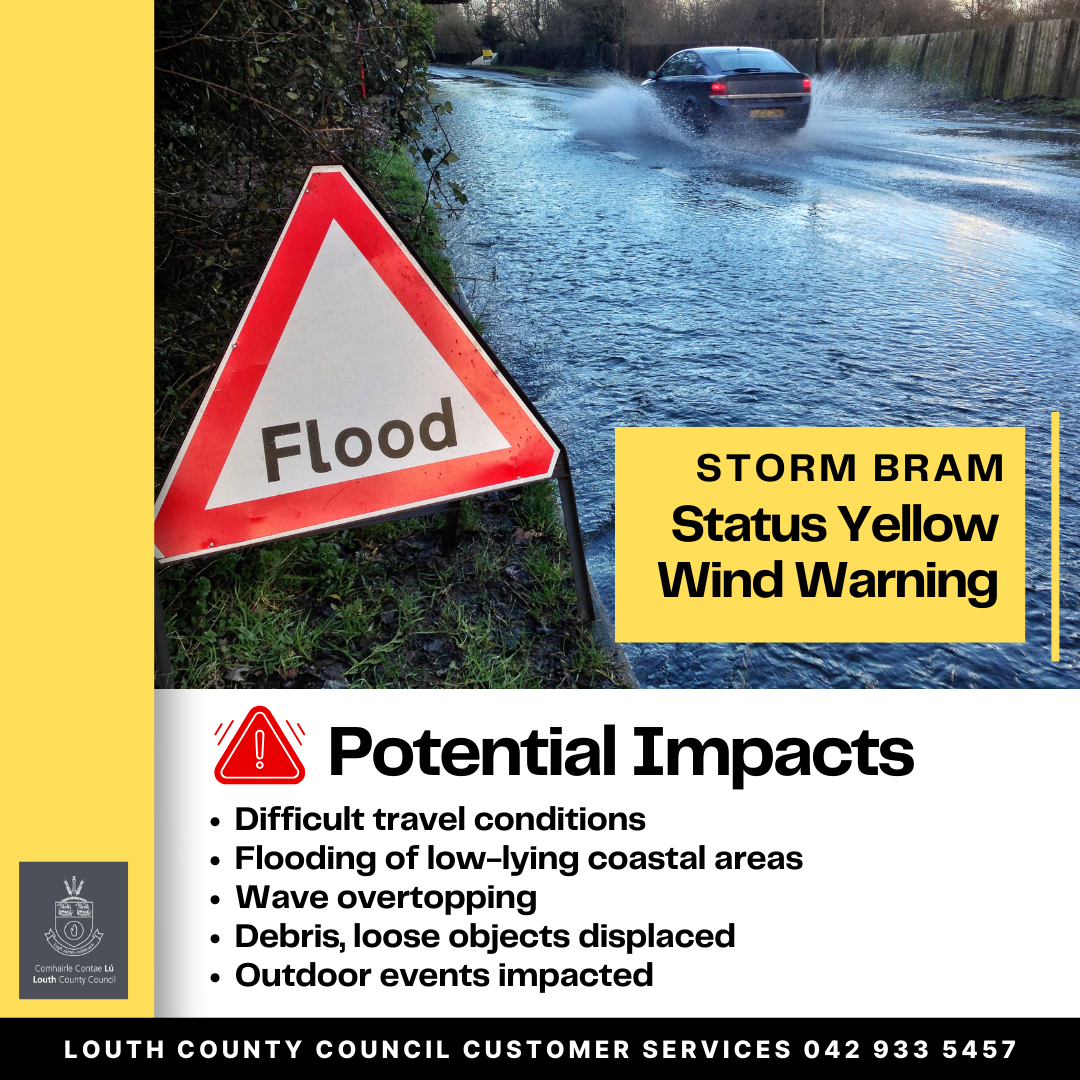
Met Éireann has issued a nationwide Status Yellow Wind Warning, which will be in effect from 3am until 9pm on Tuesday, 9th December.
Storm Bram will bring very strong and gusty southerly winds with gales possible near coasts.
There is an increased risk in coastal areas due to coincidence with very high spring tides.
Possible impacts include:
- Difficult travel conditions
- Flooding of low-lying coastal areas
- Wave overtopping
- Debris, loose objects displaced
- Outdoor events impacted
High Tide Advisory
Met Éireann has also issued a High Tide Advisory for all coasts, valid from midnight on Monday night to Wednesday, 10th December.
Storm surge levels combined with high tides and wave action are predicted to significantly increase coastal water levels, beginning on the south coast early Tuesday morning and moving north into Tuesday afternoon.
Surge levels in Louth, starting overnight Monday, into Tuesday, 9th December, are as follows:
- 0.77m at Dundalk Bay
- 0.65m at Drogheda
Wellington Quay, Drogheda, will likely flood during the period of high tides. Please use an alternative route during these hours.
Public Safety Messaging
After a week of persistent rain, many rivers are approaching bank-full conditions and soils are waterlogged, increasing runoff. Any additional rainfall is likely to result in river flooding.
A period of high astronomical tides will coincide with high storm surge and onshore winds, increasing coastal flood risk. Coastal flooding is likely, particularly during high tide times and in exposed low-lying areas.
High tides will prevent river water from discharging to the sea, causing water to back up within the channel and significantly increasing the risk of upstream flooding in low-lying areas.
Stay informed and Plan Ahead
- Monitor Met Éireann forecasts over the next 24 hrs – conditions may change quickly. Visit www.met.ie/ for the most up-to-date information. Information is also available across the Met Éireann App, social media platforms (@meteireann) and other news media sources.
- Check the Louth County Council website, www.louthcoco.ieand social media channels for information on road closures, flooding updates, and community alerts.
- Allow for disruption during Tuesday morning commute.
- Plan extra travel time and reduce speed.
- Expect surface water, debris and poor visibility on Tuesday morning.
- Check in with neighbours, older people or anyone who may need assistance in case conditions worsen.
Be Aware of Elevated Flood Risk and High Winds
- Take care on exposed roads and bridges.
- Watch for fallen branches and debris.
- ESB Networks is highlighting the dangers posed by fallen live wires and is advising the public and the emergency services to stay away from these fallen cables and to report such cases to it immediately. ESB Emergency Services can be contacted at 1800 372 999. The public can monitor www.PowerCheck.iein regard to power restoration times.
- Stay back from riverbanks, streams and canals – water levels may rise quickly.
- Keep children and pets away from waterways and flooded areas.
- Do not drive through floodwater – turn back and use another route.
- Coastal areas may experience wave overtopping, storm surge, and tidal flooding, especially in low-lying locations.
- Keep away from coastal edges, harbours, piers and low-lying promenades during high tide.
- The Irish Coast Guard advice remains: “Stay Back, Stay High, Stay Dry.”
Driving in Hailstones
The RSA has the following advice for drivers who encounter hailstones:
- If you encounter hailstones, reduce your speed, without braking if possible. Warn other drivers by using your hazard warning lights.
- Driving slowly in a high gear will help your tyres maintain grip even as your tyres move over the compacted pellets of ice.
- Accelerate and brake very gently and drive slowly on bends where loss of control is more likely. Avoid sudden steering movements or hard braking.
- Keep an eye out for road markings that may become obscured and leave plenty of distance between you and the vehicle in front.